The End of Contemporary Art

A version of this text was published in The Spectator.

Last week’s opening of the 60th edition of the Venice Biennale marks a watershed for the art world. In much of the festival’s gigantic central exhibition, curated by the Brazilian museum director Adriano Pedrosa, as well as in many of the dozens of independently organised national pavilions and countless collateral events, it more obviously than ever before didn’t so much matter what was on show but why. The politics of visibility and representation has been eating away at the arts for a decade, most recently under the banner of ‘decolonisation’. In a multipolar project like the international Biennale set against the waning legitimacy of globalisation which used to drive the art world, this organising principle is finally exposed as a wholly inadequate rationale for contemporary art.

Foreigners Everywhere, the title of Pedrosa’s project encapsulates this failing proposition. The cheap pun is taken from the 2004 work of the Italian-British artist duo Claire Fontaine whose colourful multilingual neon versions now greet visitors at the exhibition’s entrance. This is a very old trick but Pedrosa wants to reclaim foreignness altogether and thus rewrite the cultural canon. By proclaiming that to be a stranger is fundamental to the human condition, he wants to inspire solidarities between migrants, queers, indigenous peoples, and, rather bafflingly, uncelebrated dead Italian emigre artists. 
Omar Mismar

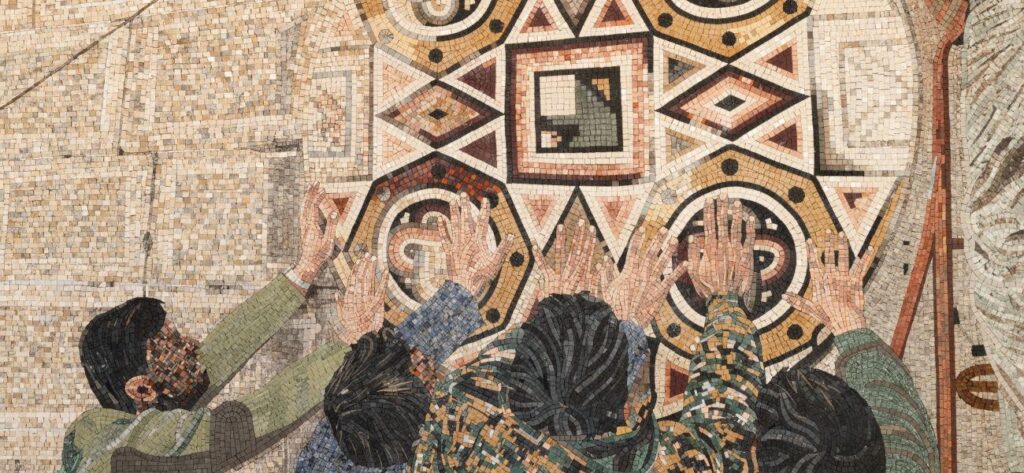
In Pedrosa’s logic, all art has the same value. This exercise is challenging even on paper because it relies on playing fast and loose with modalities and histories – like in drawing a bogus equivalence between migration and sexuality – while claiming the authority of a selectively curated museum display. Subtle mosaic works by the Lebanese artist Omar Mismar, for example, which mourn the destruction of Syrian heritage in its very medium outsmart Pedrosa’s proposal by animating material history without turning into post-hoc rationalisation for identitarian theory.

Pedrosa treats his exhibition as an opportunity to reframe the Western-centric canon. Of the over 300 artists included, many are new to the biennale circuit and half are connected to the Global South. Most are thus not easily intelligible to mainstream art audiences. The exhibition’s most striking feature is its non-contemporaneity, both in its penchant for unflashy 20th-century artistic forms and the lack of interest in the political aesthetic characteristic of today’s global art. The show makes few overt references to today’s pressing topics like the war in Ukraine or the conflict in Gaza. Out in the ‘real world’, like in the mass boycott of the Israeli pavilion, artists are talking about little else. 

[ppwp passwords=”venice bruno” whitelisted_roles=”administrator, editor” headline=”” description=”This text was published in The Spectator behind a paywall.” desc_below_form=”Get in touch if you’d like to read this text.” desc_above_btn=”” label=”To continue reading, you need to enter the password.” error_msg=”Please try again or get in touch if you don’t know the password.” ]

The exhibition is riddled with baffling historical gestures, like the inclusion of naïve paintings like Rosa Elena Curruchichwhich’s documents of community life during the Guatemalan civil war. These and multiple works like them could easily be overlooked as ‘mere’ folk art. What is the purpose of showing such artefacts in the world’s most significant art exhibition after Massimiliano Gioni’s 2013 Biennale show which focussed on outsider artists failed to inspire any earnest interest in these practices? Today, these works remain hard to appreciate or even differentiate without recourse to the exhibition labels which brim with unconvincing taxonomical detail. A game of bingo thus suggests itself in which an artwork that meets all Pedrosa’s criteria of foreignness wins ‘house’.

Rosa Elena Curruchich, 1980. Photo by Mateo de Mayda, courtesy La Biennale di Venezia.

This tell-not-show mode of display is destabilising to the senses and maybe intentionally so. But when more than a handful of works in the show are of objectively questionable quality, the poverty of his method is inescapable. The section showcasing migrant Italians, for example, includes a banal 1999 painting of an… armchair by Linda Kohen not for its aesthetic relevance but because the Jewish artist fled Milan in 1939. If the message of this artistic detritus is that anyone can become an artist if anyone can become a refugee, art has no further function.

With such anti-aestheticism, Pedrosa’s grand atlas signals the completion of art’s total ‘decolonisation’ after which no particular aesthetics or politics can take precedence over any other. Having initiated this process, contemporary art has made itself obsolete. Of course, this is good news only in principle because nobody seriously believes in the rootless, everything-goes egalitarian decolonial tenets. Pedrosa’s pseud-democratic curating is thus just a symptom of the art world’s ideological stalemate. In Foreigners Everywhere in which half of the artists are dead, the tension is easy to conceal.

This isn’t the case elsewhere in the Biennale. Although most of the independent exhibitions parrot the same decolonial message and many showcase indigenous cultures, their aesthetics betray the varied instrumental interests. Denmark, for example, renamed its pavilion Kalaallit Nunaat, Greenlandic for the autonomous territory. The auto-ethnographic work of the photographer Inuueq Storch is a feast of depravation and nostalgia. The project is a peculiar catch-up ritual which extends a 21st century politics of documentary photography to the territory’s supposedly deep indigenous culture. But we learn little of the latter and one wonders how deep Storch’s understanding of the forces at play is. A decolonial narrative, however, is taken as read.

By contrast, Brazil’s exhibition Ka’a Pûera by the indigenous artist Glicéria Tupinambá which plays with the symbolism of the capoeira bird is at first confusing to the decolonialist because even the familiar meaning of the project’s title as a martial art is an appropriation. The political reading of Tupinambá’s aesthetic gestures might again be decided externally. Such works demand the development of an aesthetic apparatus that does not reduce them to ethnic curio or commodify them as trophy art world trinkets. There is no reason for this aesthetics to be compatible with contemporary art.

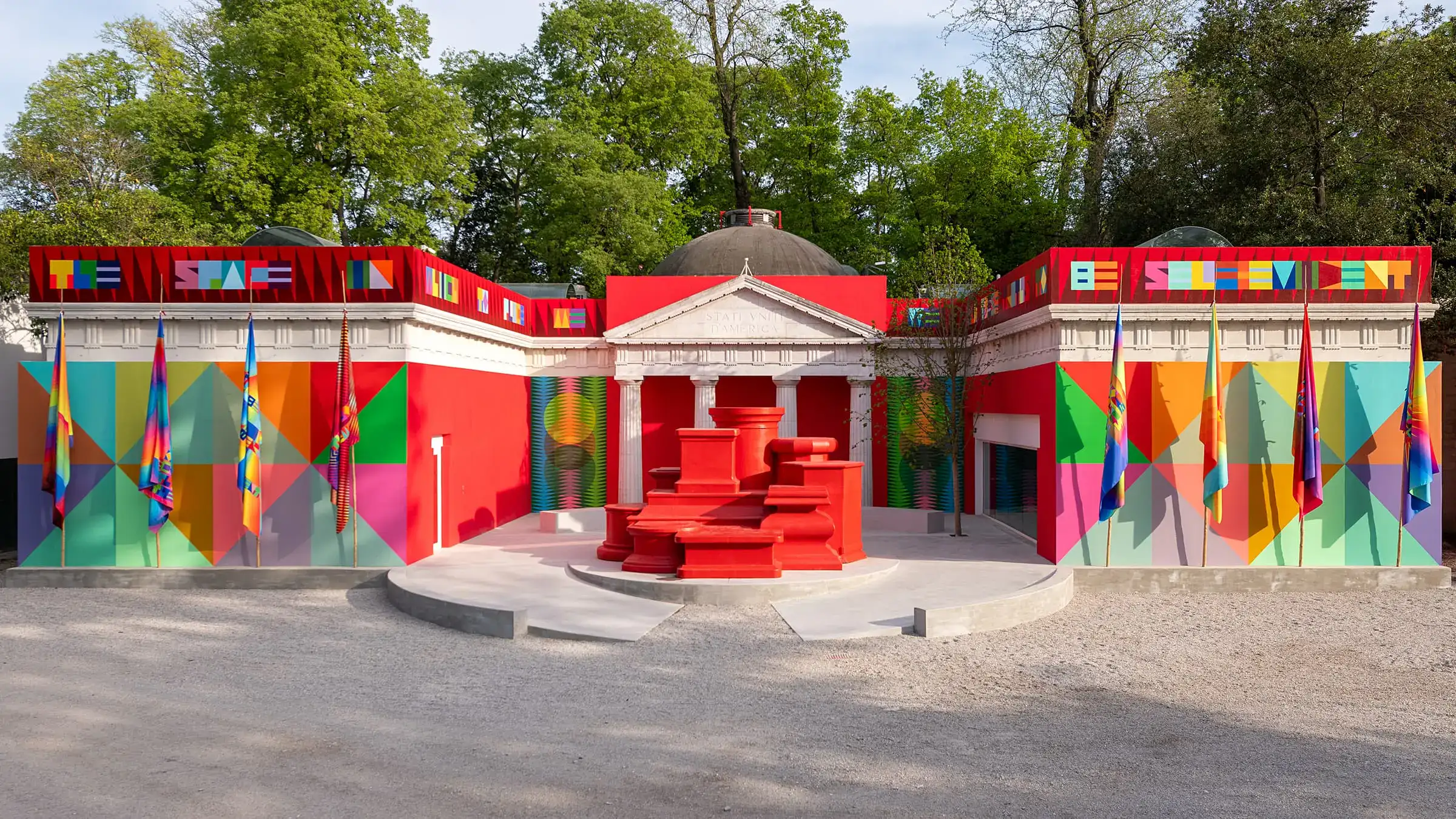
In the Australian pavilion, the artist Archie Moore litigated the state’s crimes against the First Nations with piles of legal documents and a dark display that purports to trace a 65,000-year family tree. This painful but also fabulist account earned the artist the Biennale’s Golden Lion. The Native American artist Jeffrey Gibson’s US pavilion, meanwhile, mixes strands of low queer culture with pseudo-liberatory political sloganeering in what resembles a children’s soft play centre. Such self-satisfied nonsense, at least, is on-brand for the country’s cultural diplomacy.

John Akomfrah, Listening All Night To The Rain, installation view at the British Pavilion

The filmmaker John Akomfrah’s presentation in the British Pavilion encapsulates the aesthetic dilemma of making art under such conditions. Listening All Night To The Rain is an engrossing video installation of some thirty interlinked channels and dozens of hours of footage. It brings together disparate but subtly interwoven themes such as exile, the passage of time, migration, or the flow of water. Akomfrah poses anorak-clad figures on sea breaker walls and arranges record players and metronomes among tropical fruit. These are gently seductive yet unnerving images which inspire questions about the settlement with history that produced them. This is the artist’s career-crowning work. It is severely undermined, however, by a heavy-handed curatorial text which reads like a corporate statement by the exhibition’s commissioner British Council. It precludes any ideologically non-compliant reading of the artist’s already political and theoretically informed visuals, thus throwing their quality into doubt.

Under a better aesthetic regime, forcing an already acquiescing artist’s hand would be the cause for a rebellion, as was the case in Venice in 1968, for example. A handful of presentations that deftly play with the day’s spent ideological slogans, thankfully, quietly salvage contemporary art’s ruins in this edition. In the first-ever Ethiopian pavilion, the painter Tesfaye Urgessa portrays groups of people who are both enveloped and emboldened by history. They are half vulnerable and naked, half protected by symbols of tradition and knowing. This project curated by the poet Lemn Sissay knowingly invokes Prejudice and Belonging in its title and deploys old ethnographic tropes to at once critique and profit from them. In the ideologically and astatically bankrupt Biennale, these spirited gestures are as necessary as air.

[/ppwp]

The 60th Biennale Arte continues until 24 November 2024.
Main image: Jeffrey Gibson, the USA pavilion.

×