For as long as I can recognise myself in my memories, a recurring image has accompanied my mornings. On waking, before I bind my consciousness to physical reality by clawing at the phone resting on the cabinet to my left, I first imagine reaching into the drawer of the unit on the bed’s other side. From it, I retrieve a handgun, which is loaded and whose safety mechanism has been disengaged. My fingers fit the grip and the trigger as unthinkingly as they will wrap around the phone moments later. In an uninterrupted, unhesitating motion, I bring the gun’s muzzle to my temple and shoot.
There is, of course, no gun. Not only because such items are difficult to come by, but because my daily-imagined suicide takes place only at the edge of feasibility. It would not occur to me to extend my conscious resources to procuring the weapon, for example. Nor do I have the time to consider the possibility as I lie motionless. And it is the gun’s immateriality that becomes its foremost feature. As I press the piece to my skin, I know that I do not feel the cool of its steel. I do not see the weapon, either, as my eyes are open, yet still resist sight.
If it is too early at that point in the ritual to snap out of the dream, it is also already too late to hope and stay in it. Realising that my morning would not, after all, find its resolution in death brings no relief. Instead, sleep gives way to doubt, since I do not know what consolation I had missed out on. I know nothing, for example, of the soothing sound of the pin slipping as I pull the trigger, or of the burning smell of the simultaneous ignition. My recognition of these sensations would have been curtailed anyhow, I reason later, as the neural connections vital to auditory and olfactory perception became severed by the bullet penetrating my skull.
The recoil which my body experiences even in the bullet’s absence finally wakes me. And it is with the inevitability of consciousness that the real horror emerges: the unavoidable realisation that I must, after all, remain alive and that the choice not to was never truly in my hands. Any despair which I occasionally feel, which could conceivably occasion a suicide attempt, turns, in that moment, from a terminal condition into an initial one. Suicidal despair, in other words, becomes the necessary order of life.
I do not believe that my experience is isolated. Yet, because I feel no need to be comforted in my condition, I do not understand this recurring vision to be ‘suicidal ideation’. What I describe here does not fall into the category of the ostensibly declining ‘mental health’ of the general population, either. My ideation does not even have suicide per se at its centre. Again, there is no gun in which to put a bullet. I am not Leonard Cohen’s Nancy who slept with “a forty-five beside her head” and, helplessly, “an open telephone”.
How to make sense of this image, then, when the image contains the means of its own erasure? As I experience partial aphantasia, that is, the inability to hold an object aesthetically in the mind’s eye, I cannot even be certain that what I picture is a gun. Waking to discover the weapon’s lack is the most tyrannical form of iconoclasm. The choice is between killing the image and being killed by it.
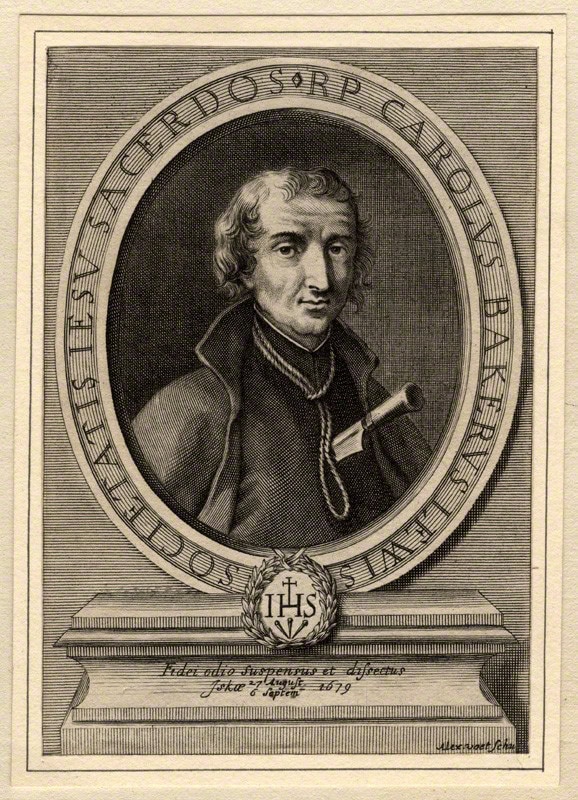
A quaint iconographic convention suggests that this is a perennial problem. Engravings depicting Christian martyrs, such as the seventeenth-century Welsh Jesuit priest David Lewis and the earlier English clergyman Edmund Campion, show the men with knives sticking out of their chests. The subjects are alive; Lewis smiles softly in Alexander Voet the Elder’s portrait.
These are extraordinary pictures. They become even more bizarre when one understands how the martyrs met their deaths in reality. Those knives which fail to kill them are, in art history, mere euphemisms for the already euphemistic punishment of being ‘hanged, drawn, and quartered’, imposed on the saints as faith traitors.
To live as if with a knife stuck in one’s chest might be preferable to being violently tortured to death. But is it not an even greater horror that there was, in truth, no knife at all? The blades in the images are decoys, as is my gun, mere stand-ins for a fate that could not be adequately symbolised by such objects. The idea of a freeing death is but a ruse in the mind of someone living. It distracts, as Damien Hirst’s formaldehyde shark once did, from the tragedy of life.
Indeed, these engravings’ abstractions didn’t do the priests any favours after their gruesome deaths. It wouldn’t be for centuries that their martyrdom become recognised by the Catholic Church. As if to add insult to injury, the conceptual instruments of their torture, rather than the far more horrifying hooks or torture racks, became (and here comes another euphemism) their customary ‘attributes’. The pictorial knives both symbolise and entirely conceal the depth of the martyrs’ suffering.
If there is any fleeting correspondence between Lewis’s and Campoin’s lots and mine, it is in the inaccessibility of reprieve in death, conjured as if it were a possibility by the printed knife or the imaginary gun. The idea of putting a weapon to its terminal use brings with it some perverse pleasure (hence Lewis’s feint grin, I fancy), but its fading from the imagination makes space for the much more manifest discomfort of never being able to exercise this option. Likewise, the lightness of the saints’ attributes symbolises that it is not primarily the manner of their deaths that is worthy of recognition. Rather, it is the true cruelty of life that requires sainthood.
The gun wants to return to me during the day. As if trying to overcome my aphantasia, a fragmentary image of the weapon forms in my mind. As it does, it turns from an object of functional interest to a subject of aesthetic fascination. I find myself reaching for it in my coat pocket as I walk through the park, I feel for it next to the notebook in my bag. It is now the explicitly sensory experience of the artefact itself that I long for. My curiosity for the gun’s weight and the texture of the engraved grip heightens. I picture this item as though it were an ornament. The weapon, like Lewis’s knife, turns into an amulet, or worse, a fetish.
What if the art historically conditioned iconoclastic impulse is so ingrained in my mind that, in truth, I picture nothing at all? It is possible, for example, that the aesthetic understanding of the gun’s impotence was brought to my mind by Tom Ford’s 2009 adaptation of Christopher Isherwood’s novel A Single Man. That man is George, a college professor, overwhelmed by grief and heartbreak after his lover’s death. His torment is so profound that it barely finds any expression in dialogue, and not much more in action. Instead, the camera lingers on the subjects, suggesting that they are themselves lingering in longing. As it does, we understand that this rhythm is mortally unsustainable.
Ford follows George, played by Colin Firth, meticulously arranging his suicide. The bereft man rehearses putting a gun into his mouth, dines with a close friend for the final time, and writes a considerate note to his housekeeper. An encounter with Kenny, a student, disrupts these plans. Ford invests Kenny, portrayed by the then-youthfully beautiful Nicholas Hoult, with enough charm to wake George from his stupor. The curiosity which the young man feels for his elder has the appearance of love. Yet this is only temporary. This love prevents George from dwelling on suicide, but because it is not the love that George mourns, it can do nothing to alleviate the horror of his staying alive.
George dies of a heart attack in the night. Kenny, who had earlier taken the gun out of the man’s reach, is asleep on the sofa, unable to save George the second time. Ford’s film, which takes its hero’s singularity for granted to the point of barely mentioning his lover Jim’s fatal car accident, opts for a fairytale ending. But Isherwood’s version speculates that George’s death had already taken place many times over, that George’s coronary artery began hardening the very moment he’d set his eyes on Jim.
Love, in other words, is death. It is always death already, even when it is synonymous with life. This may seem like contrarian dialecticism until one tries to temper it by gripping a gun, only to discover that this mode of escape is fantasy. The point is not only that life conjures the fear of death, or that George’s relationship with Jim was always already overshadowed by the inevitability of its end. Rather, the horror of life or love lies in the specifically unknowable nature of their end. Given the certainty of Lewis’s knife or George’s gun, who would choose to live, to submit themselves love, to this slower, far more torturous death, one impossible to frame in the mind of someone so living?
Main image: Portrait of Saint David Lewis by Alexander Voet, line engraving,1683.