This text first appeared in the April 2026 issue of The Critic.
One of the signs of reaching the professional middle age is that one begins to consider one’s life’s work in quasi-historical terms. The juvenile artistic experiences which shaped one’s early career acquire the a colour in light of later events. It becomes easier to understand why some of the projects one built with youthful energy faded into insignificance. Many convictions of early adulthood have faltered, exposing some earlier certainties as dubious.
In the art world, the professional midlife crisis is brutal and hiding behind the third-person “one” is no use. A collective “we” is not much better, because the crisis affects the cadres unevenly. For an art critic who, like I, was once an art dealer and a faithful adherent of the cult of contemporary art, hindsight is a blessing. My experience helps me to make sense of what art has become today. But it is also a curse because it lands me with some responsibility for not halting art’s catastrophic decline. This, only partly fictional story, is my and my generation’s mea culpa.
Having come of age in the final years of the last millennium, I was primed to become embroiled in the irrational optimism of Britain’s rising creative economy. Despite my sixth-form careers advisor steering me away from art school, my creative urges got the better of me. After a degree in physics and stints in drama, publishing, and photography, in 2006, I headed for Central Saint Martins.
My artistic aspirations aside, I remember the art school programme including patchy lectures on “professional practice”, some vain hope that Charles Saatchi might visit the degree show, and the faculty’s insistence that building a “peer group” — were they the “common people” of Pulp’s song? — was the course’s key outcome.
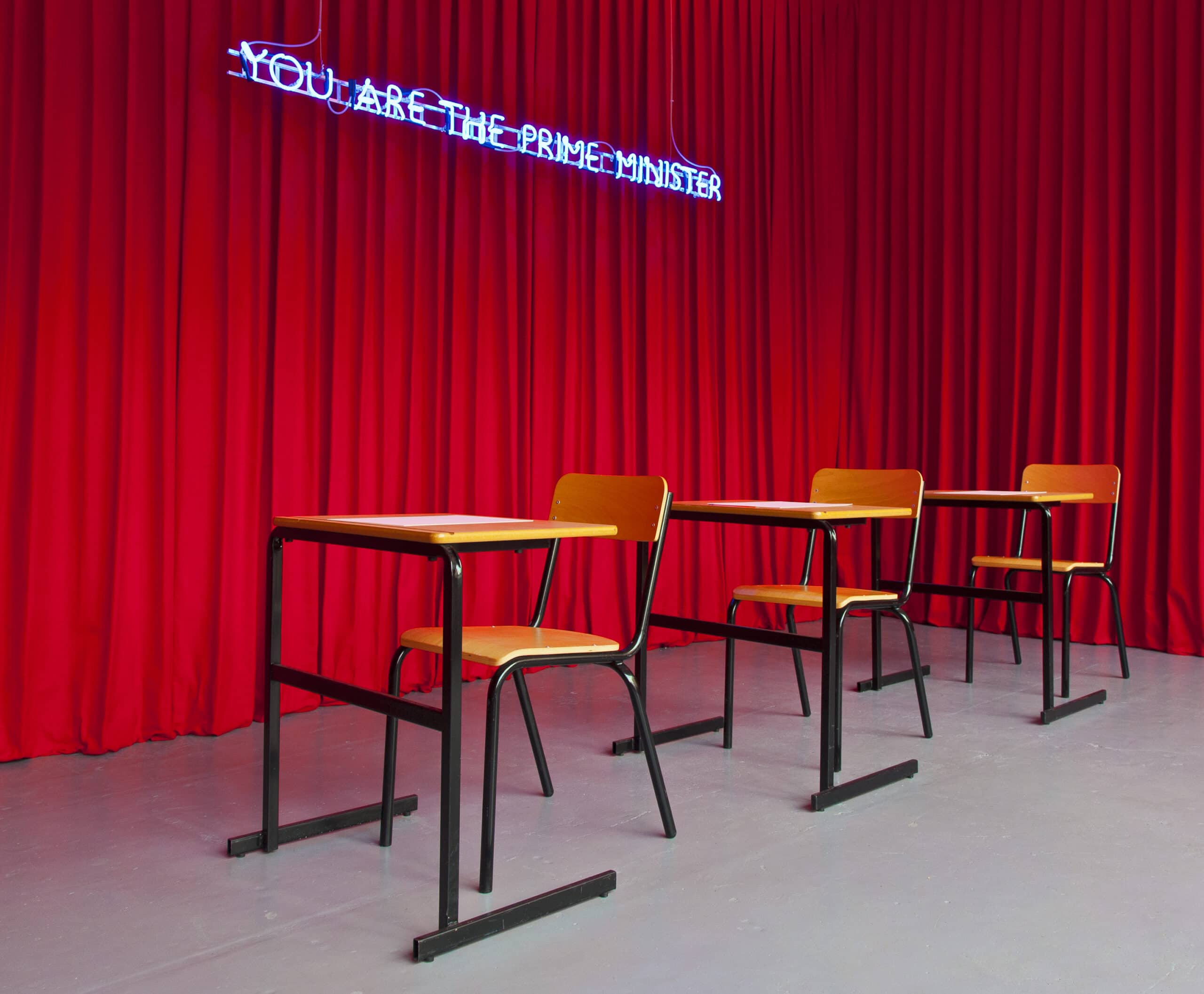
Main image: Karen Mirza and Brad Butler, You Are the Prime Minister, 2014, installation view.