This essay first appeared in the October 2026 issue of The Critic.
Of all the rhetorical tricks used to alter the fabric of Western culture, the proposal that “X has always been Y”, often counterfactual, and that, therefore, “more must be done to make X into Y” is the most pernicious. This logical fallacy has been deployed in battles over class, sex, and national identity. Now, at the peak of neoliberal culture’s globalism, the claim that Middle Eastern art has long been “contemporary” gives rise to the idea that Western contemporary art itself is a natural vehicle for Islamic thought.
This fusion seems unlikely at the outset. Yet, after three decades of auction houses courting oil sheikh wealth, museum franchises pitching outposts in deserts, and Western curators favouring foreign artists as if they were exotic birds, that Dubai is an art world capital is a given. With a Muslim population steadily growing in Europe, neither does the idea of cultures here mixing permanently. “Islamic Futurism” is now a bona fide critical concept in Western contemporary art criticism. But did all this happen as organically as the rhetoric suggests?
To begin with the story, one must first understand that for the average artworld intellectual in London or New York, pointing to the “Middle East” on a map is challenging. Falling educational standards aside, this might be because art speak loves totalising hybrids that let the users of this language off the hook. While exhibition listings will routinely designate that an artist was born in, say, Iran, curators would prefer to speak of “Persia”. The Middle East thus turned into “MENA” in art funding circles to include North Africa, before adding “SA” for South Asia to the acronym.
Such shortcuts, deployed to encourage geographic diversity in the programming and collecting in the institutions, obscure the fundamental differences between their constituents. This partial account inevitably does so, too. The Middle East, then, survives in distorted denominators: Islam and oil reserves. Many critics, such as Anthony Downey, who in the 2010s edited the online magazine Ibraaz focusing on MENA art, observed that the region’s development would inevitably fall prey to the forces of global capital. Could the Louvre’s branch in Abu Dhabi, which opened to great fanfare in 2017, meaningfully bridge the cultural gap between the East and West in the name of universalism, when it was part of the city’s $27 billion place-making investment package?
Indeed, for parts of the region, such questions were fuel for a branding and development masterplan. It is astonishing how fast the Gulf states jumped at the opportunities of contemporary art. The first edition of Sharjah Biennial, for example, took place in the United Arab Emirates already in 1993, long before such events became marketing junkets and the art world’s key mode of coordinating ideas in European cities. This Biennial came into its own a decade later under the direction of sheikha Hoor Al Qasimi, who trained at London’s Slade and the Royal College of Art.
The Western art world was then obsessed with marginal national identities and their political potential. Al Qasimi turned Sharjah into a locus for intellectual and aesthetic discussions on these themes, thus posing questions of leadership for a Middle Eastern future. Since 2008, she has hosted the March Meeting, a summit for contemporary art practitioners connected to the MENASA region. This event soon attracted the art world’s vulturous luminaries, such as Hans Ulrich Obrist, and thus became a venue for high-profile ideological exchange.
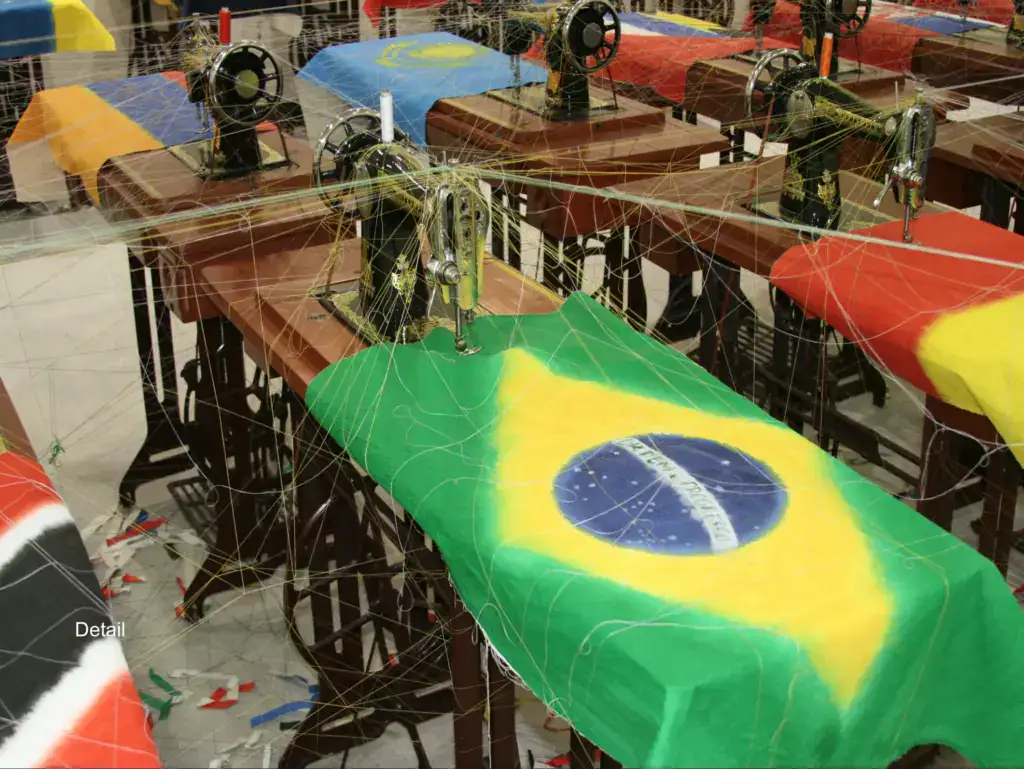
Sharjah’s internationalism appeared ambivalent at first. The Indian NS Harsha’s giant 2007 installation Nations, exhibited in the Biennial, consisted of rows of sewing machines weaving together the flags of the member states of the United Nations. Was this a critique or an endorsement? Like many works of its ilk circulating in exhibitions of the time, it fuelled the slow realisation that the relationships between states and their cultures were not immune to manipulation. Yet, even as Western countries were opening their borders, the Gulf’s cultural industry deployed the same internationalist aesthetic precisely to protect itself from the downsides of cultural globalisation.
Main image: MIPSTERZ, Alhamdu — Muslim Futurism, 2021. Courtesy MuslimFuturism.com.