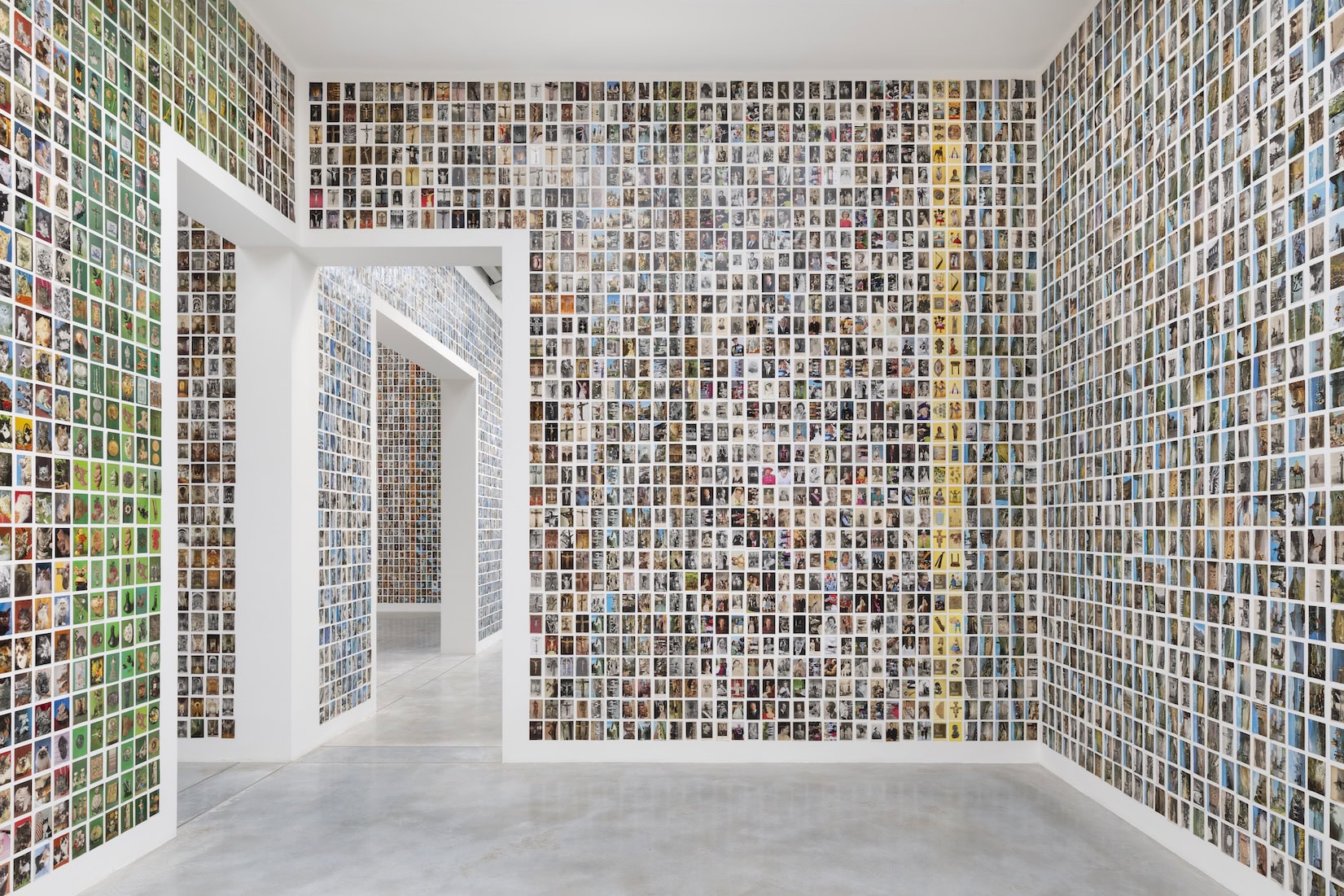
In what at first looks like a gimmick, Vilanova has filled the Spanish pavilion’s walls with many thousands of vintage postcards. The rectangles hung in dizzying geometrical perfection depict European cityscapes and landscapes, cultural artefacts, and landmarks both geographic and historical.
The curator suggests that the arrangement is non-hierarchical, that the images are removed by the collector’s gesture from their vital milieu. But this is nonsense: a postcard still carries its context on verso, and in the exhibition, one is before long overpowered by Villanova’s choice and grouping of his subjects.
Hundreds of the pictures in one corner show ornate cathedral doors, elsewhere many dozens bear the faces of twentieth-century Popes. Cats get their own field, as do toy dolls dressed in period costumes. They share a wall with antique mosaics, not far from dramatic mountains and marbles of Christian saints.
The dance of the constellations is never ending, which makes their critique counter-intuitive. In it, the non-linear totality of Western creation — a “civilisation”, as Kenneth Clark may have put it — inspires awe.