This review originally appeared in The Critic.
Every artistic movement needs its rebel poet. Such iconic figures gain cult followings both for their creative daring and their often tragic downfall. For my tail end of generation X, this part was played by Nirvana’s frontman Kurt Cobain, whose grunge performances — or so I understood from my teenage friends more attuned to popular music — challenged establishment aesthetic norms. Cobain was an odd choice of an idol, not least because the lyrics of his hits, which he complained his critics often mistranscribed, were frequently banal or outright nonsensical.
As entertaining as it may have been to bop to “I found it hard, it’s hard to find / Oh, well, whatever, never mind” of Smells Like Teen Spirit, I missed out on this trend. Just as the guitarist’s suicide in 1994 — which taught those same friends that angst was an unavoidable companion of puberty — affirmed the guitarist’s meme poet status, I was preparing to move away to a boys’ boarding school where such popular cultural interests were frowned upon. I needed to pick a more palatable bad boy hero for my juvenile affectations.
The French poet Arthur Rimbaud, remembered then over a hundred years after his death as much for his precocious literary bravado as for his youthful beauty, became the object of my emulation. Unoriginal, yet befitting of a young homosexual as my choice was, the cult of Rimbaud attracted me aesthetically as much as his work did linguistically.
The well known photograph of Arthur aged seventeen, which graces the covers of pocket editions of his poetry, inspired me to wear a silk ribbon bow around my neck. Agnieszka Holland’s 1995 film Total Eclipse, which cast Leonardo Di Caprio as the teenage poet, fed my whimsy. At one point, I was so consumed by Rimbaud’s verbal antics that I devoted months to — once again, epigonically — translating them into English.
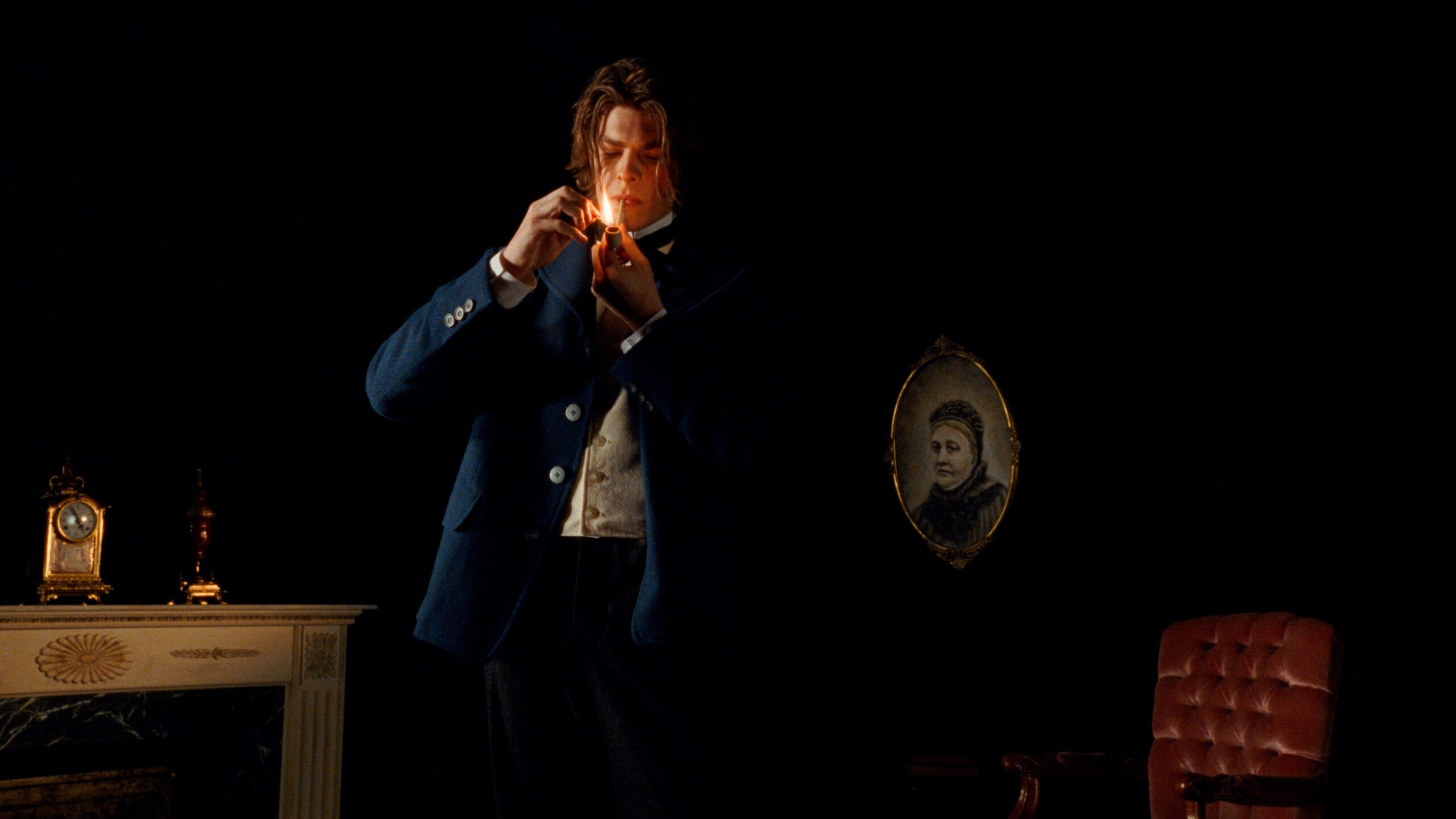
I exaggerate the distinction between the aesthetic and poetic affect of this icon from my hazy memory. But that same division lies at the centre of the portrayal of A. Rimbaud in Patrick Wang’s just-released film of that title. The austere biopic, shot entirely on a sound stage, has only one character. For nearly three hours, the Australian actor Blake Draper monologues to the camera as Arthur. All his counterparts — from his lover Paul Verlaine shooting at the poet in pathetic rage to his mother visiting him on his death bed — are played by musical instruments heard from outside the frame.
This conceit, even when taken as an arthouse affliction, demands that the film is read not as a film, or not primarily as a film, already from the first scenes. A. Rimbaud could be a dramatisation of Rimbaud’s legendary affect, except that the director deprives his star of all the foils requisite for drama. It could be a stage play, except that Wang wants us to tire of looking at Draper’s handsome face in close-up. Instead, A. Rimbaud shares with its hero the linguistic excesses of his poems, the very ones that made Rimbaud’s downfall inevitable. “I know the evening. / And dawn exalted as a flock of doves, / And at times I have seen what man thought he saw!”, writes Arthur in The Drunken Boat.
Rimbaud, the character, lends himself to projection into quasi-historical romanticism, despite the poet being the progenitor of literary modernity. It is far easier to subject Arthur’s life to this treatment than his words. The tale of a runaway teenage prodigy-cum-rebel who charms his way into the Parisian cultural scene only to denounce its staid forms is a scintillating twist on the more commonplace narrative of the outsider artist who, like Cobain, reaches the top of the charts.
That Arthur did this as he was pitifully in love with one of the Parnassian literary regime’s foremost men has inspired generations before mine to venerate his image. The American artist David Wojnarowicz’s 1990 series of self-portraits wearing that Rimbaud photograph as a mask, for example, became iconic not for the literary association but because of the photographer’s relationship with the older Peter Hujar and his contemporaneous AIDS diagnosis.
A. Rimbaud could have fallen into this trap, but Draper’s Arthur is more alienating than he is seductive. Because in many scenes the actor has no one at all to play against, his monologic attempts at drama bear a degree of implausibility. In the inclusion of trombones and violins, which inevitably fall short of representing real characters, A. Rimbaud’s words must rise to the bar of poetry. And this poetry, as the film reminds the viewer, failed to secure loyalty even from the cowardly Verlaine.

This is what separates Rimbaud’s life from his writing. So strong is the appeal of the aestheticised narrative that many outright forget that Rimbaud’s end was neither tragic nor poetic. In what Albert Camus described as a “spiritual suicide” — a far graver cultural infraction than Cobain’s self-inflicted death — Arthur abandoned his literary project and retired from writing at the age of twenty.
A. Rimbaud tells the aftermath with a modicum of biographical fidelity, taking many of Draper’s lines from Rimbaud’s letters from Abyssinia, where the former poet spent over a decade trading coffee and arms. Rimbaud’s dealings with French merchants were marked by an impatience recognisable from his earlier love affair, for example. Yet his relationship with the king of Shewa (a territory in modern-day Ethiopia with Addis Ababa at its centre), while financially disastrous, indicated that the mature Arthur developed a greater respect for the customs of his adopted milieu than he had ever felt for the French cultural establishment.
The still single-sided telling of this period of Rimbaud’s life, historically longer and more eventful than his Paris and London years, finally casts the teenage Arthur himself as a poet rather than a cypher for poetic affectation. Draper, deprived by Wang of all relationality, here entirely lacks the interiority that we associate with artistic genius. This Arthur is empty and bound to remain alone. His personhood is constructed solely by his utterances. He — and this becomes true of both the poet and the actor — does not exist save for in language.
To understand this in contrast with the aestheticised version of Rimbaud is to mark the shift between literary Romanticism and modernity. It is also to grasp the power of words to sentence the poet into exile (Rimbaud learned many languages and Draper’s accent changes erratically from scene to scene). The arms dealer Rimbaud of the 1880s thus makes sense of the young Arthur who quizzically assigned colours to vowels a decade earlier: “A black hairy corset of shining flies, / Which buzz around cruel stench, / Gulfs of darkness”. Language — no match for Wang’s chamber orchestra that cacophonously haunts Rimbaud — condemns them both.
This is a perverse takeaway from watching a beautiful young man reciting Wang’s translations of one of the nineteenth century’s greatest poets who still finds affection among many such young men. But both these lines and Rimbaud’s life prove that language can destroy romantic ideas even as it gives rise to them.
It has been twenty years since I thought of Rimbaud. Yet recently, on a date with a younger man, who may well have resembled Arthur for the sake of this story, I caught myself doing what Draper does on screen without understanding the consequences of Wang’s game. With every provocative line I spoke, I became more convinced that I was no more than assembling a poem, one that existed completely outside me. Love was alluded to in this conversation but only to laugh it into syntactic impossibility. The evening left my heart racing as I accused myself of having subconsciously rehearsed all my words in advance, perfecting them in grammatical isolation that could but distance their object.
Is this what poets feel like, and can one ever cease to be one? It may not be worth asking here what became of Verlaine. Better to abandon Cobain as the subject of lyrical inquiry and make nothing of the fact that Wojnarowicz died at the same age as Arthur. In the closing lines of Illuminations, Rimbaud pre-emptively rejects such sentiments: “Down with these superstitions, these other bodies, these couples and ages. This is the time which has gone under!” His poetic proposals have had consequences, and A. Rimbaud is bound to enact them.
A. Rimbaud plays at ICA, London in August 2026.
Rimbaud poems cited in translation by Wallace Fowlie.