This review was originally published in The Critic.
“Pick one concept and never stray from it” is the kind of advice that one may imagine being dispensed to art school students in the 1990s. If the Guyanese-British artist Donald Locke (1930-2010) heard the maxim when he studied at the Bath Academy of Art in the mid-1950s, he turned it to his advantage. His fixation with black, the colour synonymous both with the absence of any other and the deepest depth of colour saturation, gave rise to a compelling vocabulary which only grew with practice.
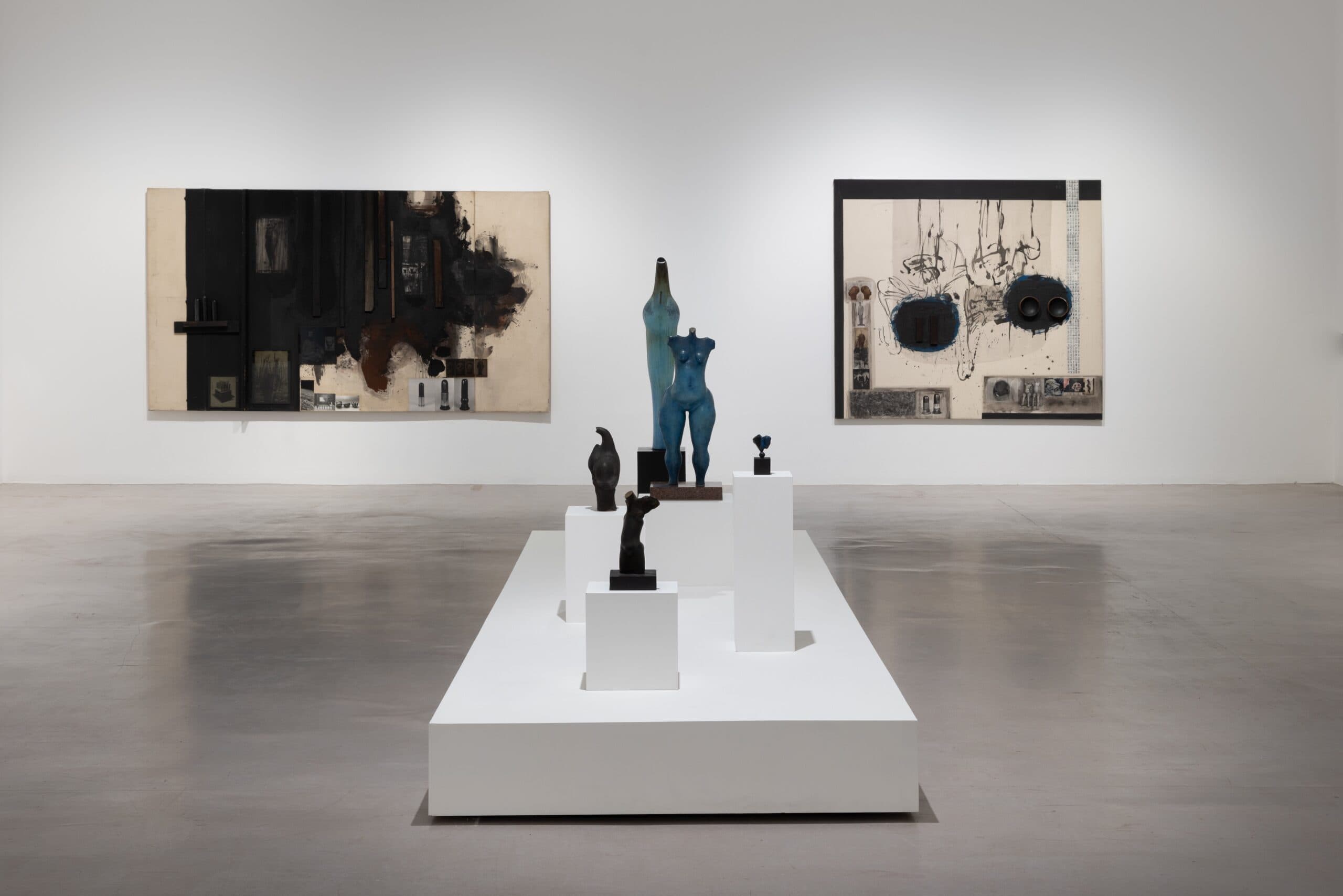
As narrated in Resistant Forms, a retrospective at Camden Art Centre, Locke’s oeuvre is remarkable in its conceptual restraint and firmness. The display, with clusters of canvases and ceramics from the 1970s, ’90s, and the 2000s, shows an artist testing the expressive limit of his chosen media. They, in turn, also test their subject.
Locke’s calling card is a cast of rich black ceramic obelisks, which resemble truncheons, phalluses, or artillery shells (depending on their environment and the viewer’s frame of mind), which he set in trophy cups or candlestick holders, embedded in his canvases, or simply posed at the roadside. These objects feature in a variety of assemblages, such as Trophies of Empire 1972-74), a wooden cabinet in which the items are displayed as though in a second-hand store on Portobello Road, and Redoubt (1972), which resembles the chassis of a high-end audio valve amplifier of the era.
There is no getting away from the biographical in Locke’s work. Sugar plantations remained a feature of the Guyanese economy long after the former colony gained independence from Britain in 1966. Works such as The Cage (1967), a black, quare canvas in which patches of fur are bound by steel, establish the legacy as an unfading interest. Yet, despite these reverberations, Locke treats the subject of Empire with a studied ambivalence. Canvases from the Dynasty, The Birth of Empire series (1989), made just before the artist moved to the US, are veritable cryptic puzzles brought together to confuse a simple reading.

A recurring feature of these surfaces, primed with burnt sienna, is an expanse of black acrylic paint. Locke applied it to create high contrast textures on some, crusty fields in others, and uniform stains elsewhere. What is striking in these assemblages is their ability to incorporate other techniques and other messages within, and not merely against the black expanses. In one frame, the artist combined a photograph of a formal political gathering, a record from the early days of aviation, and photographs of his own ceramic works — confusedly shaped vessels reminiscent of those for which Locke’s tutor at Corsham, Kenneth Armitage, became known — only to once more break the image’s austerity with rectangles of fur.
Donald Locke, Resistant Forms at Camden Art Centre continues until 30 August.
Main image: installation view of Donald Locke, Resistant Forms at Camden Art Centre, 2026. Photo: Rob Harris.