This review originally appeared in The Critic.
There are concepts so fantastical that the only way to disprove them is in their wholesale, unencumbered acceptance. Pan-Africanism, the idea that a tacit solidarity binds the 1.5 billion inhabitants of the African continent with a worldwide diaspora and that this unity will one day lead to the emancipation of the globe, is one such runaway project.
Pan-Africanism has spread primarily through the efforts of the intellectual circles in Europe and the Americas. Project a Black Planet, an exhibition and series of events at London’s Barbican, tests the notion’s enduring influence and the convictions of the artists who continue to animate it in over 300 artworks.
Unlike today’s realpolitik formations, such as the African Union charged with protecting the integrity of the continent’s nations, Pan-Africanism specifically transcends geography. The Barbican’s exhibition begins with the French Moroccan Yto Barrada’s 2010 wooden puzzle Tectonic Plate, which rearranges the world map, Pangea-style, with only Africa central and immovable. Nearby is the Belgian Edith Dekyndt’s video Native Shadow (2014), which shows a flag made up of black hair flying in the sky of Martinique. The “Pan” of Pan-Africanism is thus the white man’s making.
The project is also transhistorical. Dekyndt’s work refers to events of the transatlantic slave trade that took place after its abolition and draws on theoretical developments that came even later. Throughout the exhibition, contemporary and twentieth-century works contend with archival materials. The first vitrine includes an invitation card to the 1900 Pan-African Conference, held in Westminster Town Hall and co-organised by the civil rights activist W.E.B. Du Bois. Next to it is a poster for a 1970 New York event with the Jamaican activist Marcus Garvey, whose political doctrine promoted black ethnic nationalism and his installation as a provisional president of Africa.
Project a Black Planet calls this “world-making”. This term has been in vogue in the art world of late, and its ubiquity conceals the bravado and unrestrained imagination necessary to for Pan-Africanism to have got anywhere at all. It is extraordinary to consider today, after decades of the concept’s dominance in cultural institutions, that the construction of black identity needed to be offshored to the West.

At the Barbican, works of the Cuban Chinese painter Wifredo Lam highlight this complexity. Lam, a Cubist and Surrealist, rubbed shoulders with the likes of Matisse and Picasso during his time in Europe. His 1944 Altar for Elegua, a deity of a Cuban and Yoruba blend of Spiritism and Catholicism, is a luminous assembly of natural motifs, sculptural elements that dwell somewhere between life and representation. Above all, this loosely painted oil on paper is a work of Western Modernism that makes a claim on Modernity as an African phenomenon.
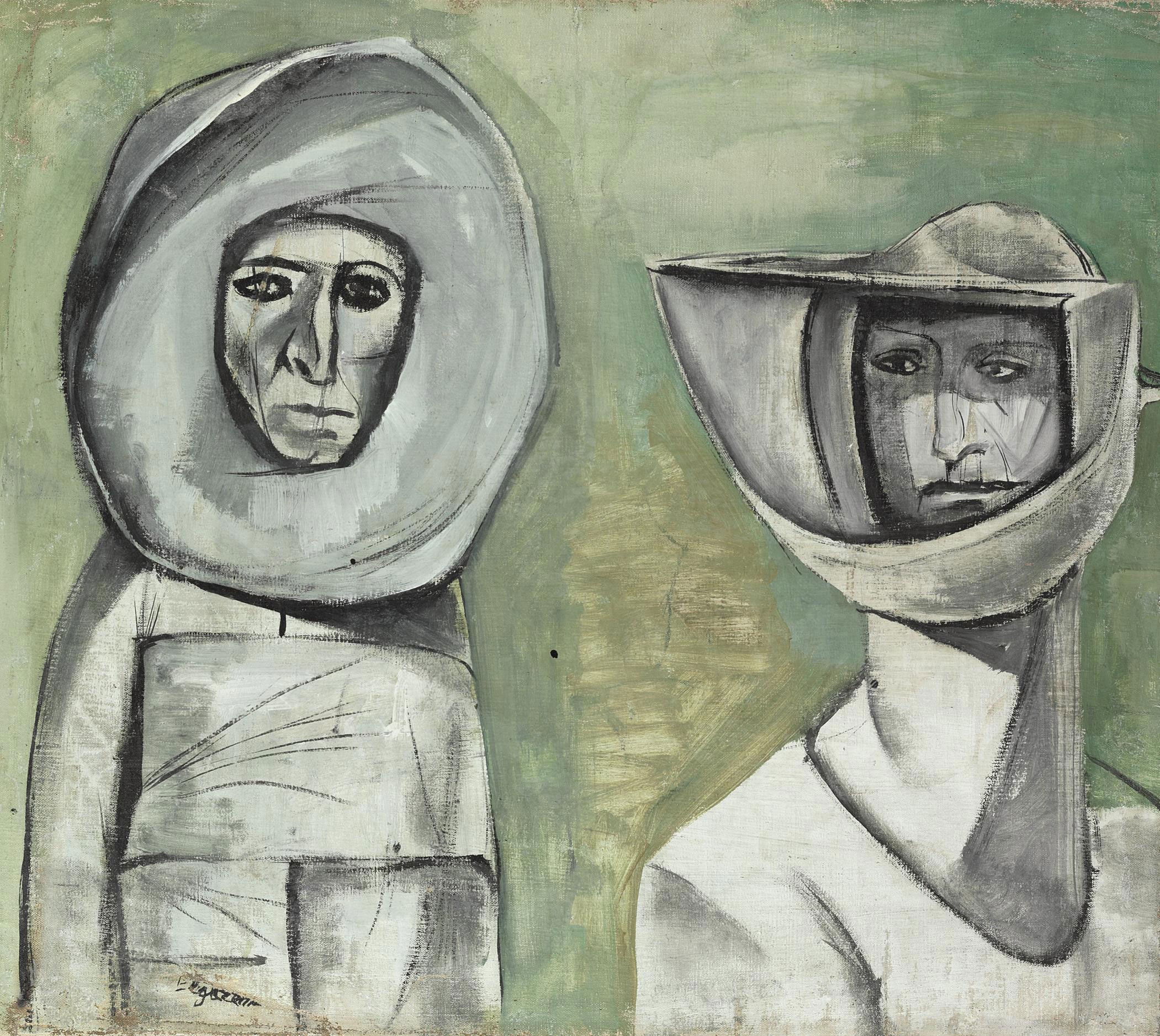
Project a Black Planet, The Art and Culture of Panafrica continues at Barbican Art Gallery until 6 September. Main image: Abdel Hadi El Gazzar, Two People in Space Outfits, early 1960s. Courtesy of Barjeel Art Foundation, Sharjah