This review originally appeared in the June 2026 issue of The Critic.
When the German Chamber of Culture planned the 1937 exhibition Entartete Kunst (Degenerate Art), it must have felt great confidence in the effectiveness of the Nazi propaganda machine. After all, the official rejection of Modern art had previously only led to bolstering its popularity. The 1863 Salon des Refusés, for example, strengthened the standing of Manet and Courbet, while the exclusion of Duchamp’s Fountain from a 1917 exhibition became a legend of its own.
Staging the display of some 650 “degenerate” works of condemned avant-garde art confiscated from German museums head-to-head with The Great German Art Exhibition, a show of regime-sanctioned works, was the culmination of Hitler’s four-year cultural revolution. Since the Nazi party held absolute control over what art could be shown and how, the success of this initiative was as good as guaranteed.
In The Worst Exhibition in the World, art historian John-Paul Stonard narrates a visit to Entartete Kunst, a display of paintings and sculptures by the likes of Otto Dix, George Grosz, Max Beckmann, and Oskar Schlemmer. The text dwells on many of the densely hung show’s highlights, such as Ludwig Gies’s 1921 Lübeck Cathedral crucifix (vandalised) and Franz Marc’s 1913 The Tower of Blue Horses (now lost). It also accounts for Nazi attitudes to art and, by addressing the reader in the second person, presents a veiled warning for the present. The book is rich and compelling in its treatment of the artefacts. Yet the shortcuts it takes with its psycho-political analysis undermine the sense of aesthetic determinism with which it approaches one of the most significant interventions in art history.
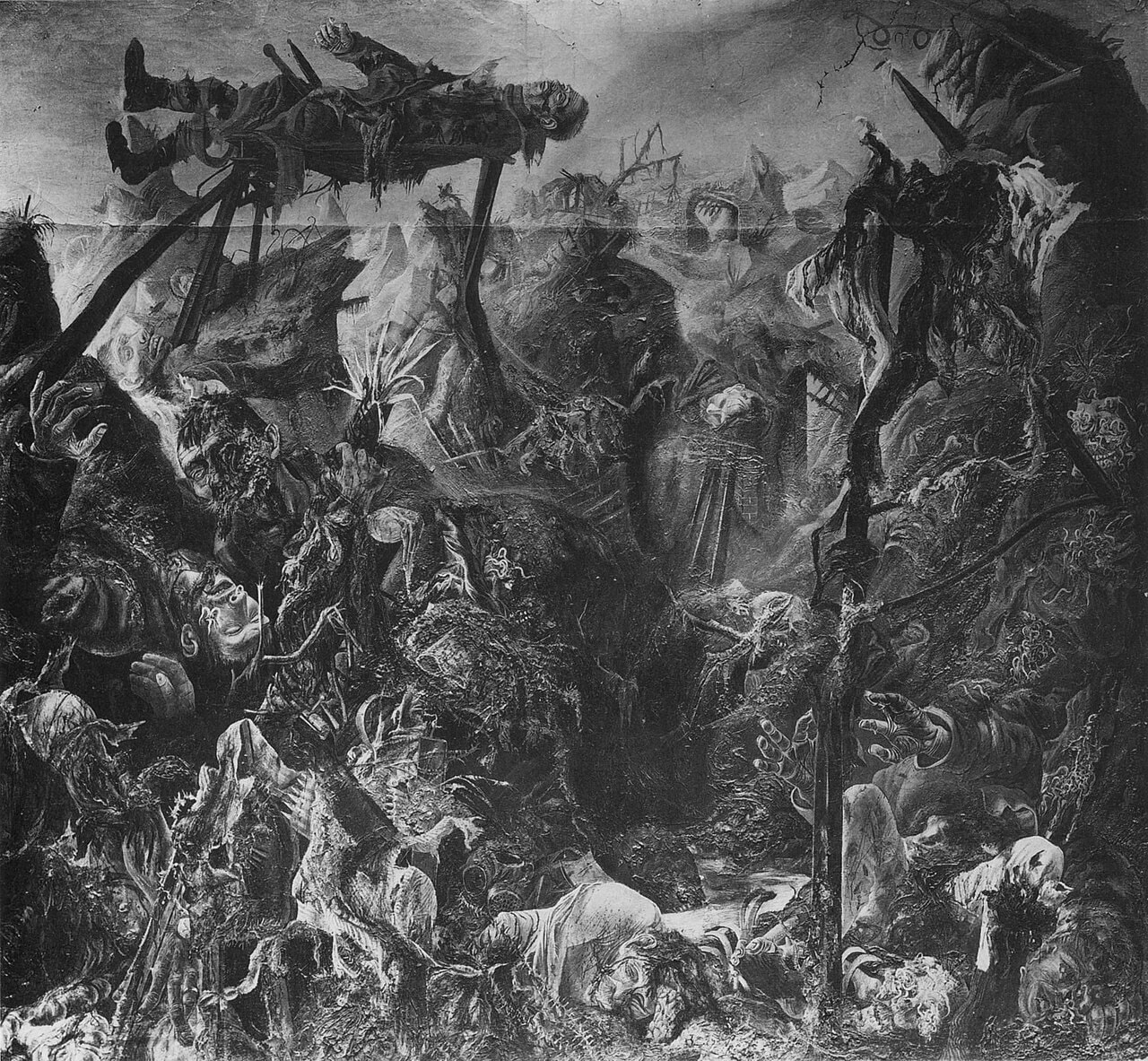
Main image: Otto Dix, Der Schützengraben, 1923. The Worst Exhibition in the World: Degenerate Art, 1937 by John-Paul Stonard is out with Old Street Publishing.