This review originally appeared in The Critic.
Readers of this magazine are not likely to look to contemporary art to find the pulse of Britain. Even less so, perhaps, to the Turner Prize, which in recent editions turned inward and has barely represented even itself. This year’s show, however, catches contemporary art distracted, pulling in multiple directions at once, and blindly misinterpreting the images it makes. In this, it is more ‘Britain in 2026’ than Britain cares to admit.
Marguerite Humeau, whose installation opens the show, is French and exhibits primarily outside Britain. She is also the best known of the shortlisted four. In a week the argument about Rishi Sunak’s Englishness reemerged, the formality of her nomination — in recognition of an exhibition in Denmark — meets with resignation.
Not so for the work itself. Behind a white cloth hanging, Humeau hides a white elephant, its cries audible before the sculpture can be seen. The foam and latex animal lies in something resembling flight — the trunk and tusks point straight ahead — but could also be the shape of agony. A soundtrack of tribal or industrial funk comes and goes, as does a pounding sequence of the elephant’s gradually expiring heartbeat.
This last element is the work’s most affecting until one spots an artificial heart, a pump filled with water, which completes ECHO, A Matriarch Engineered to Die (2016). Still, the human viewer’s heart cannot but synchronise with the animal-machine’s. The installation plays a trick on our cardio empathy, sentencing us to death, too, as if in punishment for posing as the ultimate intelligent designers of Humeau’s ecosystem.
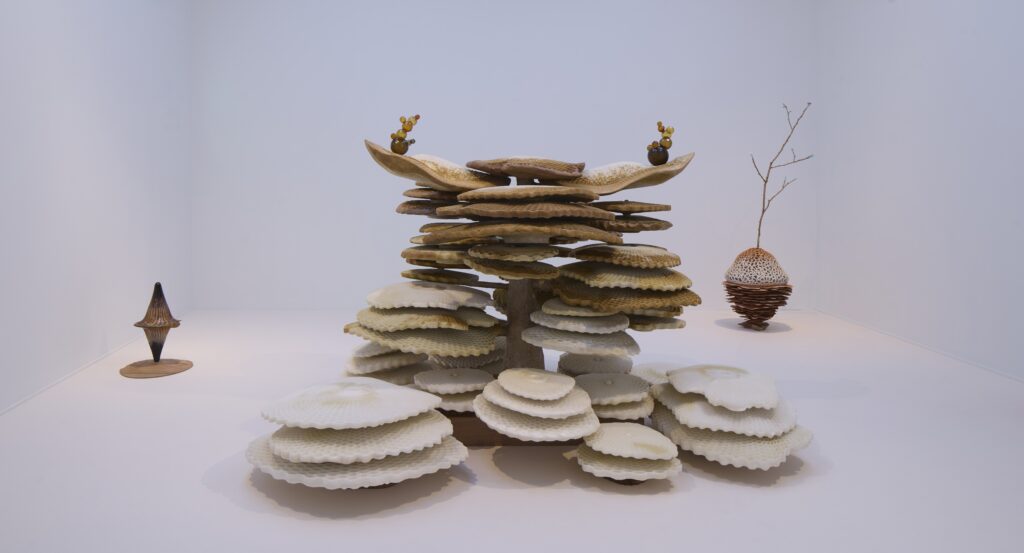
In another, even whiter room, Humeau further pursues the more-than-human. The Holder of Wasp Venom (2023) is a constellation of wax honeycomb trays, some coated in propolis that gives the sculpture a faintly inviting scent. An arrangement of laetiporus fungi made out of beeswax adorns a tree trunk beside, with hand-blown glass ornaments completing the installation.
All this is a clash between the “organic” and what we assume is synthetic intervention. Yet Humeau is haphazard in her proposals, allowing the same materials to mean one thing here and another there. Her crutch is a tiresome conceptualism of overloaded descriptions — “150-year-old walnut (cause of death: unknown)” — or, in other presentations, dramatic lighting.
The theatrical is also a tool in the thirty-odd object installation by the sculptor Kira Freije. Her figures, made of aluminium casts of human limbs held together by stainless steel racks, are sometimes playful and charming, at other moments sentimentally dramatic.
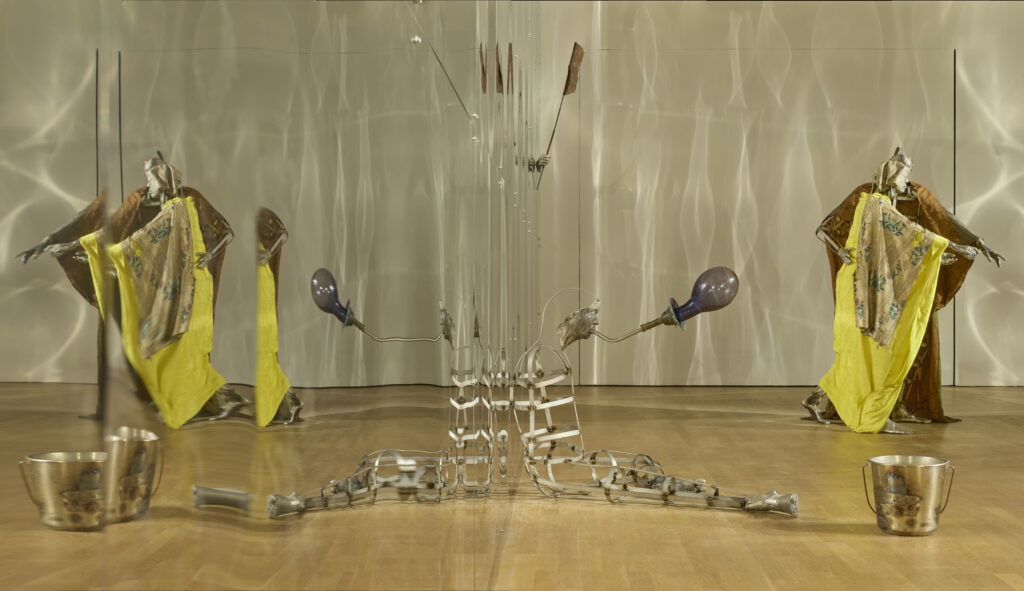
Freije frames her work by steel mirrors, envelopes them in thin smoke, and pierces the whole thing with dozens of spotlights. On this stage, she pursues the sentimentally human and the quaintly domestic. In Breath that must (2025), for example, she captures a couple mid-fall. The upright woman — her face rendered in sorrowful detail, wireframe torso concealed under skirt-like fabric — supports a collapsing lover. His tearful face gives the assembly an emotional payload.
There are flights of fancy. and by its measure, encounter a wholeness (2025) has another skeleton-like figure laying on a worn sofa, its stretched-out arm holding a sizeable bird. Miniature sheep and horses (the same steel bones now covered in wool and skin) graze nearby. Numerous buckets filled with glass (each bears a different title) dot the floor, while less discernible odds and ends, such as arrows, make the exhibition feel like a walk through a prop store.
Freije’s is the kind of sculpture that wants its craft to be noted, and this lands it in a dated register. Her volumetric approach to the body is reminiscent of Antony Gormley’s and is thus now nostalgically English. But the way in which Freije handles emotion — overwrought, in both iron and kitsch — brings her close to another British cultural staple: the merchant of sentimentality Jack Vetriano.
The inclusion of the Plymouth-born Tanola Sasraku on the Prize shortlist is puzzling because her work pursues so many weak ideas that it’s impossible to care for any of them. For example, Watchlist (2025) is a chequerboard display of corporate souvenir paperweights from the oil industry. Each of these found items contains a drop of crude and is engraved with a caption such as “Damman No. 7, Saudi Arabia”. The recipient of such a trinket, one imagines, might find it pleasing for a moment, but by arranging thirty or so of them on a set of velvet-lined trays that take up most of the gallery’s floor space, Sasraku insists that they must have some greater significance.
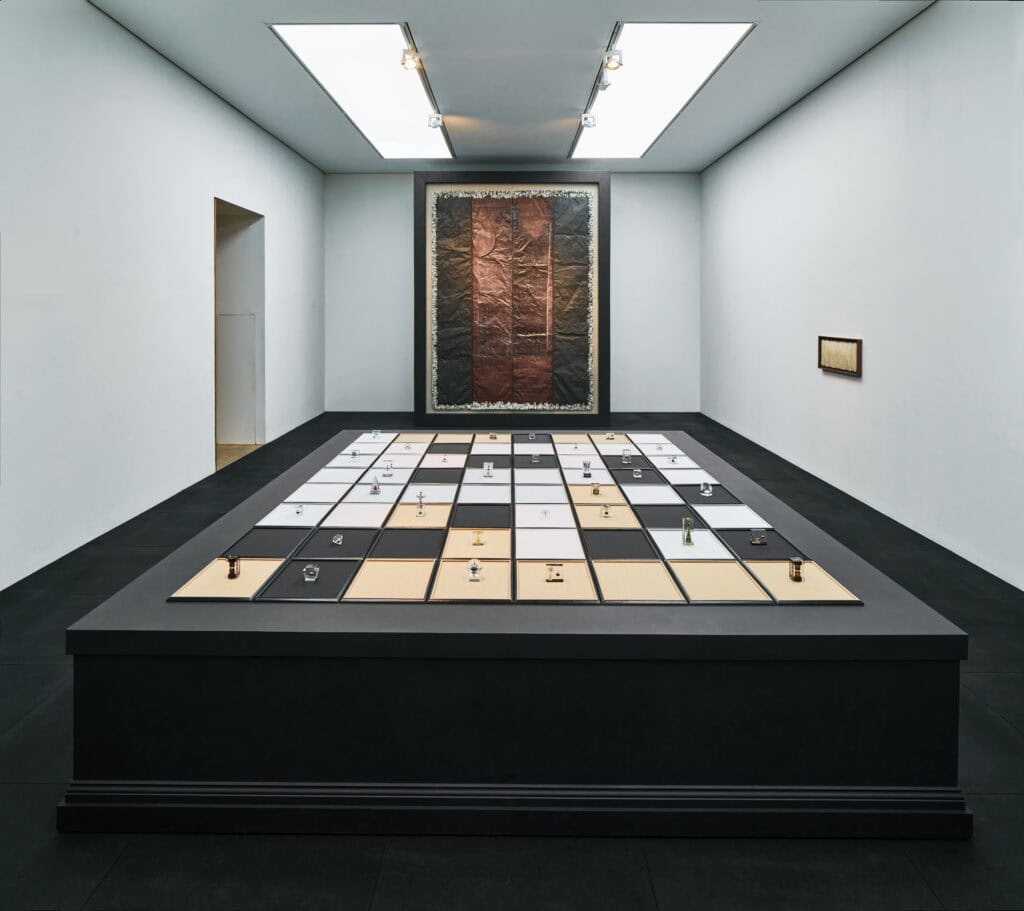
They don’t. Is the work a way of saying “just stop oil” or pointing to capitalism’s reliance on myth and emotion? Sasraku hasn’t thought this through. Neither has she considered the materials of Mascot (2025), a floor-to-ceiling assemblage of layered paper and pigment, framed in a cumbersome black board frame that makes the work a comedy competitor to Stonehenge. The shape of the papercut comes from a tailoring pattern handed down to the artist by her Ghanian fashion designer father and its colour is the result of an elaborate, yet trivial process of ageing cellulose under a sunbed.
One could say that Sasraku’s ideas are arbitrary and belong in an undergraduate artist’s sketchbook. Yet that they have been given a chance to enter a contemporary art canon is a reflection of not merely the British art establishment but of the way the country’s culture has absorbed similar notions without question. A better one might be whether such projects’ deemed inconsequentiality has, indeed, been without consequence.
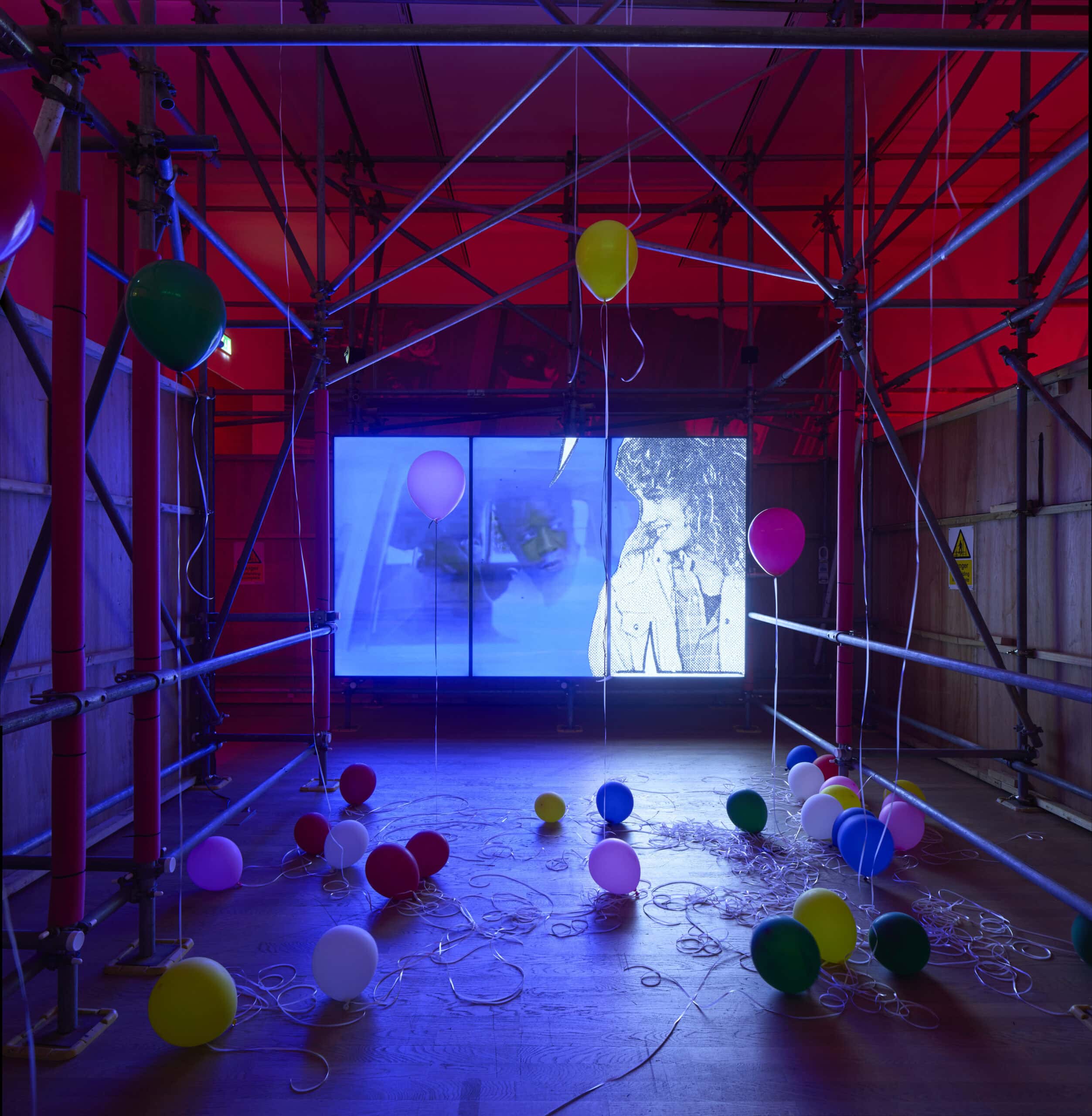
Simeon Barclay’s The Ruin (2026) is as close as art comes to meaningfully answering a rhetorical question. The Ruin is a video performance poem presented within an austere structure made of black building site hoardings and scaffolding. The space is also a balloon-filled party venue, with the neon sign for Johnny’s (2022), a club in Huddersfield, where the artist lives, that’s notoriously difficult to get into.
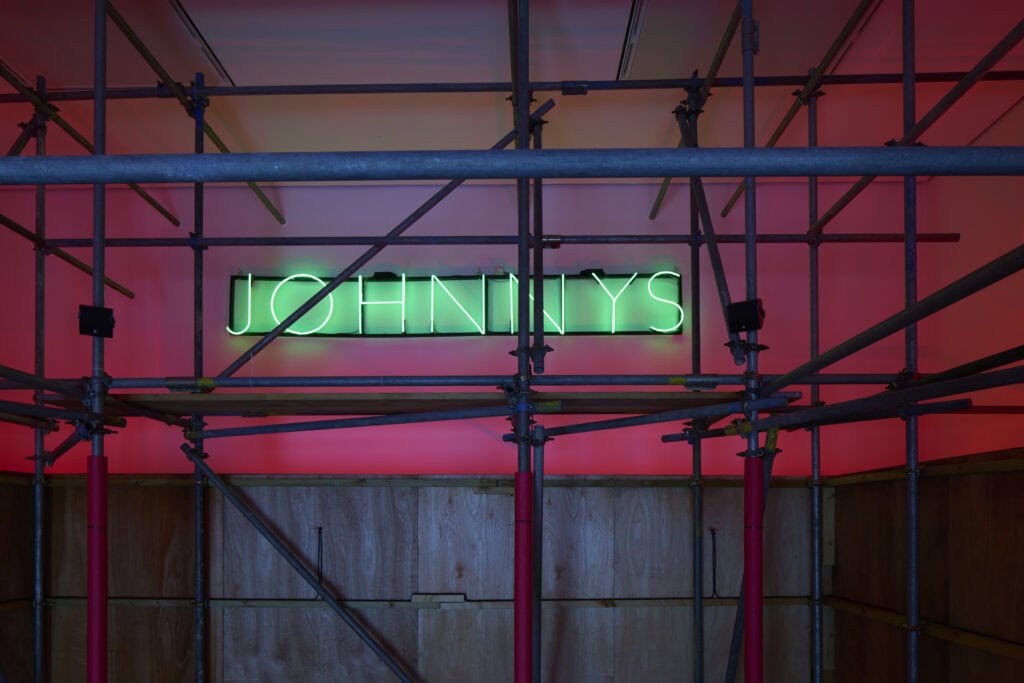
The bulk of the installation’s not-quite-looping visual plays as a backdrop for Barclay’s recitation of a perverse ode to the construction of the M62 motorway. The carving of the Pennines was one of post-War Britain’s major infrastructural projects, which, in the artist’s account, gave England’s already then changing population a sense of purpose, achievement, and mastery. Yet the poem doesn’t glibly romanticise the moment: Barclay recognises that this construction of Englishness gave its subjects “definition” but also — mirroring the language of both earthworks and migration — sought to “erode” them.
On the screen, doilies, trinkets, and chintzy interiors slowly scroll past the eye, as Barclay speaks of “the regime of living the English way”. He rhapsodises “the man of on the sofa” — a figure mirrored on a print that entirely fills one of the gallery’s walls — the master of the house who no longer owns his home and is the master of nothing. The poem’s repetition is interrupted by an archival demonstration of a fire taking hold of a domestic interior and, one cannot but understand, the same man on the sofa.
Barclay’s project is a lament and a rousing cry. Its lyrical portrayal of Northern England attends to heritage on a geological scale without neglecting the artist’s diasporic roots. In it, it is masterful and thus challenges the viewer to imagine Britian’s future without offering a declaration reducible to a headline.
The Prize exhibition this year takes place in Middlesbrough. The Northern town looks peaceful, progressive, and prosperous from the gallery’s roof terrace. Other accounts, however, paint it as a site of stifling decline. If such disjunction is how Britain fails to see itself, then this edition of the Prize poignantly enumerates the causes.
The Turner Prize 2026 exhibition continues at Middlesbrough Institute of Modern Art until 29 March 2027.
Main image: Simeon Barclay, The Ruin, 2026. All images: Turner Prize 2026, installation view at MIMA, Middlesbrough Institute of Art. Photos David Levene.