This review originally appeared in the May 2026 issue of The Critic.
In the early days of the Israel-US war with Iran, as galleries and museums in the Middle East closed, art media reported a peculiar sense of solidarity arising among the migrant cultural labour force in Dubai and Abu Dhabi. As the missile strike near-misses became the spectacle for social media, it appeared that the Gulf states’ brand new cultural infrastructure was safe. The industry’s discussions turned to the Louvre franchise’s lost tourism income.
Such concerns are not trivial. And what use is art in a war? Not in the pacifist sense of works like Picasso’s Guernica. Not in defiance or promotion of confrontation that characterised Jacques-Louis David’s Napoleonic propaganda. But, rather, how does art, as art, coincide with conflict, in recognition and continuation of its reality?
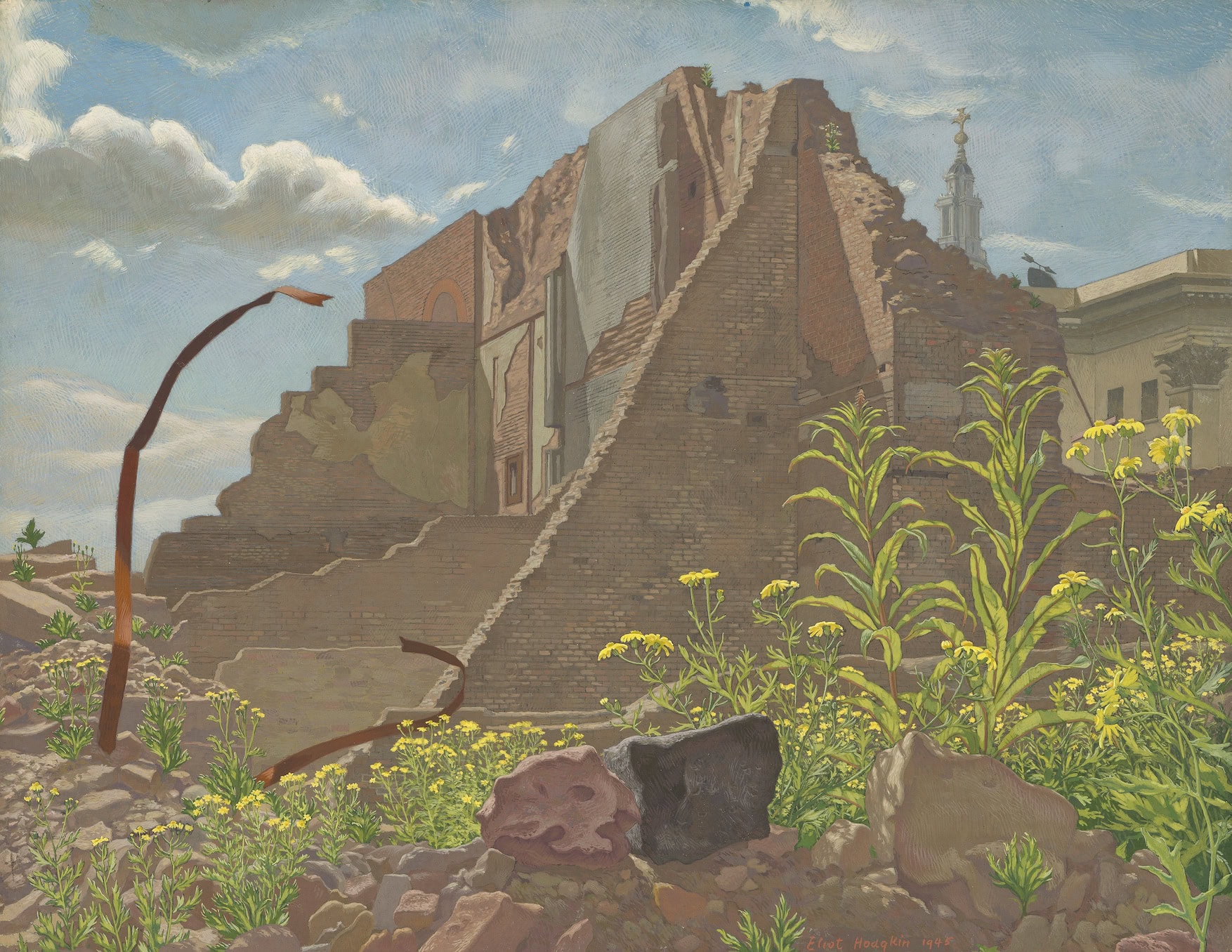
Official war artists have grappled with this question since Willem van de Velde pioneered the profession in the seventeenth century. Today, the ongoing contradictions of art’s relationship with war are evident in the very title of Beauty and Destruction, Imperial War Museum’s exhibition of nearly fifty paintings of London made during the Blitz for the War Artists’ Advisory Committee.
With works by Duncan Grant, Eliot Hodgkin, and Graham Sutherland, Beauty and Destruction is a who’s who of London’s wartime art. Looking at the images, however, one might not immediately recognise that what unites them is war. The exhibition is organised in sections like “Thames”, “travel”, and “street”. Together, they give a sense of Wartime London as the milieu of a structural conflict, one akin to that manifesting in Dubai today.
Beauty and Destruction continues at Imperial War Museum, London, until 1 November.
Main image: Eliot Hodgkin, The Haberdashers’ Hall, 8th May 1945, 1945. IWM (Art.IWM ART LD 5311).