It was once fashionable for an artist to live and work between one place and another. Giardina Papa still does. This may be why she feels affinity with a volcanic island that once appeared from the seabed between Sicily in Tunisia.
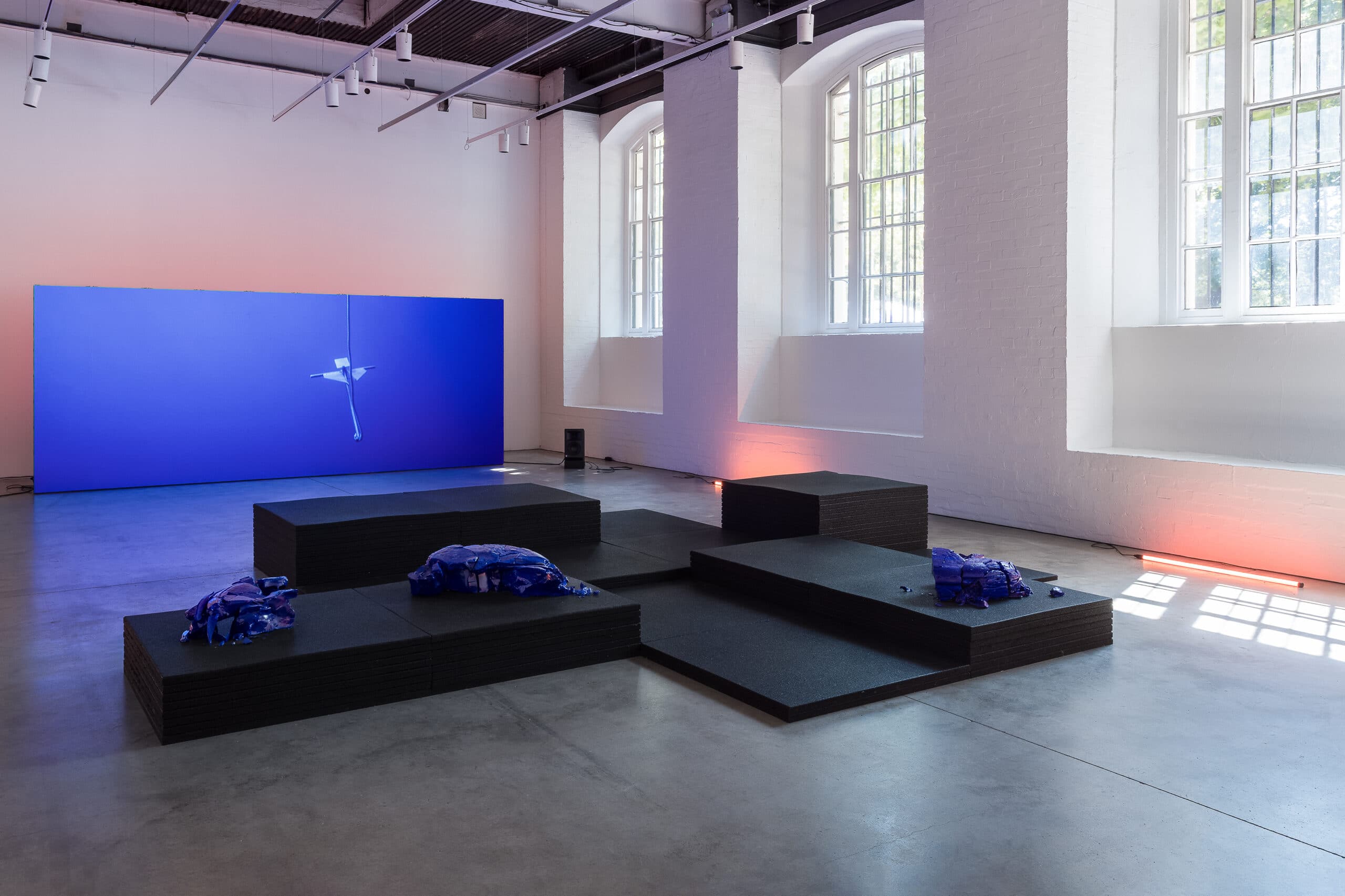
She tells the rock’s story in explosive, ultra-saturated video, stylistically advancing that dizzying 2006 Bravia television advert in which bursts of colour overwhelmed matter itself. Elsewhere, Giardina Papa scatters equally rich blue volcanic glass, fashioned into tongues and industrial bulk in wall cavities and on rubber mats.
The film’s poem lyricises sovereignty, condemns territorial claims, and confuses Odysseus, without undoing the installation’s technical sterility. Lifeless forms borne out of fire become models for liberation, the autonomy of literally and figuratively nowhere is this promo clip’s undesirable object.
Volcanoes erupt under water often, granted, but — no man is an island and all that — their formations are equally often short-lived. That Mediterranean Island sank months after it emerged, and the Glasgow tower block from Sony was demolished. Giardina Papa’s story renders transhumanist dreams more sharply than many similar artefacts. Their anchorless freedom, alas, is imaginable only in uninhabitable abstract.